Projects · what is active
Projects
Public experiments, instruments, and platforms under development by Giordano Cabral, individually or with students, at FAROL and MusTIC. Unlike the courses and papers, these are working systems, with a public address.
Measurement instruments, teaching systems, tools and public experiments, all live, each with its address and a capture of its own page.
01 · Projects
Artificial intelligence
FAROL and what came out of it: a fluency index, the instruments that apply it and the public experiments that serve as both showcase and test.
FAROL · Agentic Fluency in AI
Research group created in 2025 at CIn-UFPE, which in 2026 becomes the FAROL Institute of Agentic Fluency. It measures fluency, an organization's movement in its use of AI, rather than maturity, which is a static position. The instrument has six axes (Knowledge, Tools and Integration; Delegation and Autonomy; Processes; Productivity and Results; Learning and Culture) and five levels, from A to E; it is open and answers immediately, with no consulting in between. It is sought by organizations that already experiment with AI and cannot say where they stand, and, on the educational front, by students. The site offers open diagnostics, the repository of theories and the instrument prototypes.
- Technology: a static website with functions on Vercel and a Supabase database.
- Link:
https://farol-ia.org· contactfarol@cin.ufpe.br - Repository: private.
- Status: active.
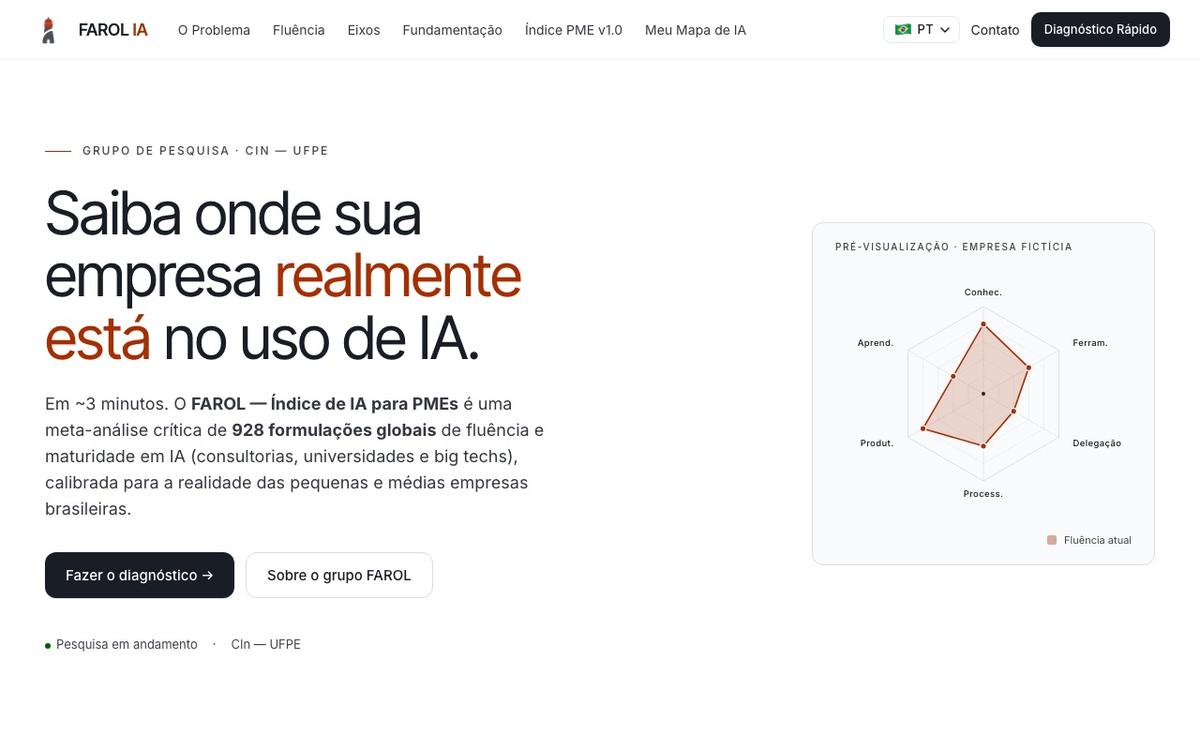
AI Index for companies
Free, self-reported diagnostic: a leader answers on behalf of the company and receives the result immediately, by axis, with no registration and no appointment. It is a synthesis of eight global frameworks, consolidated by FAROL.
- Link:
https://farol-ia.org/diagnostico - Status: active, version 1.0.
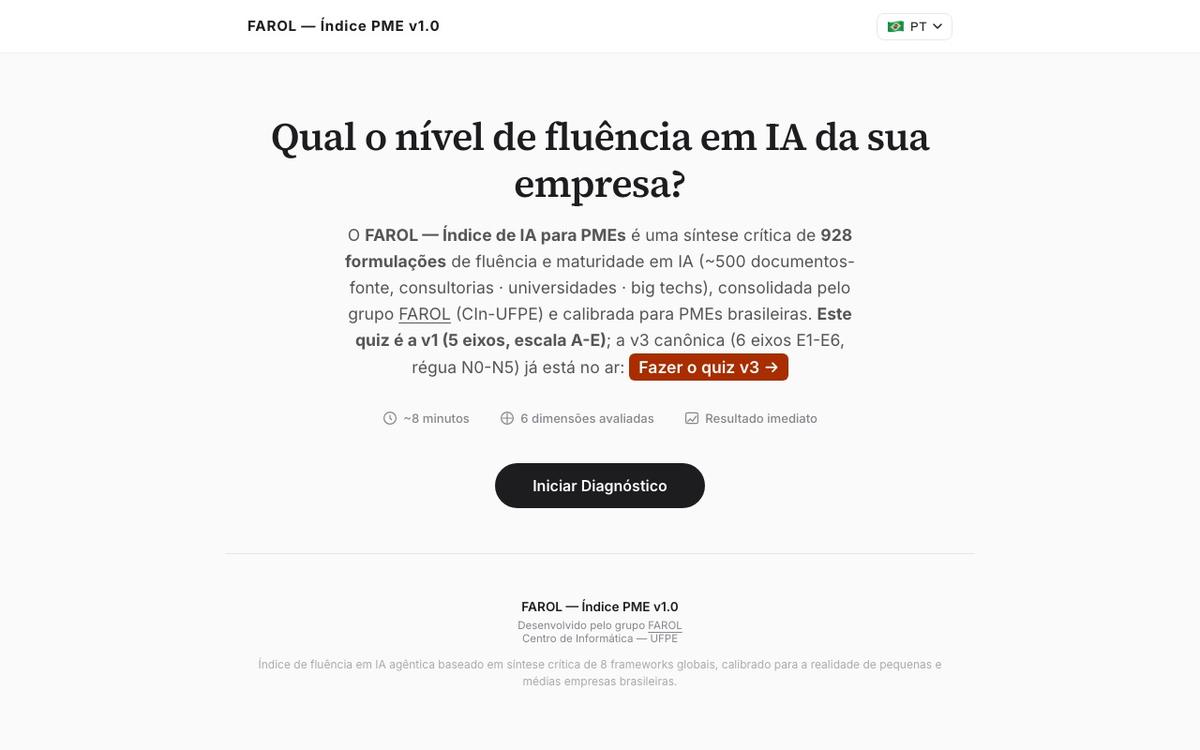
Assessment prototype lab
Six ways to answer the same diagnostic without it looking like a form: Nested Bubbles, Garden/Mycelium Sunburst, Living Constellation, Leap Map and Box of Little Balls. Nothing is saved: it is a bench for comparing interfaces, open to those who design research instruments and want to see the alternatives side by side.
- Link:
https://farol-ia.org/lab/ - Status: active, prototype.
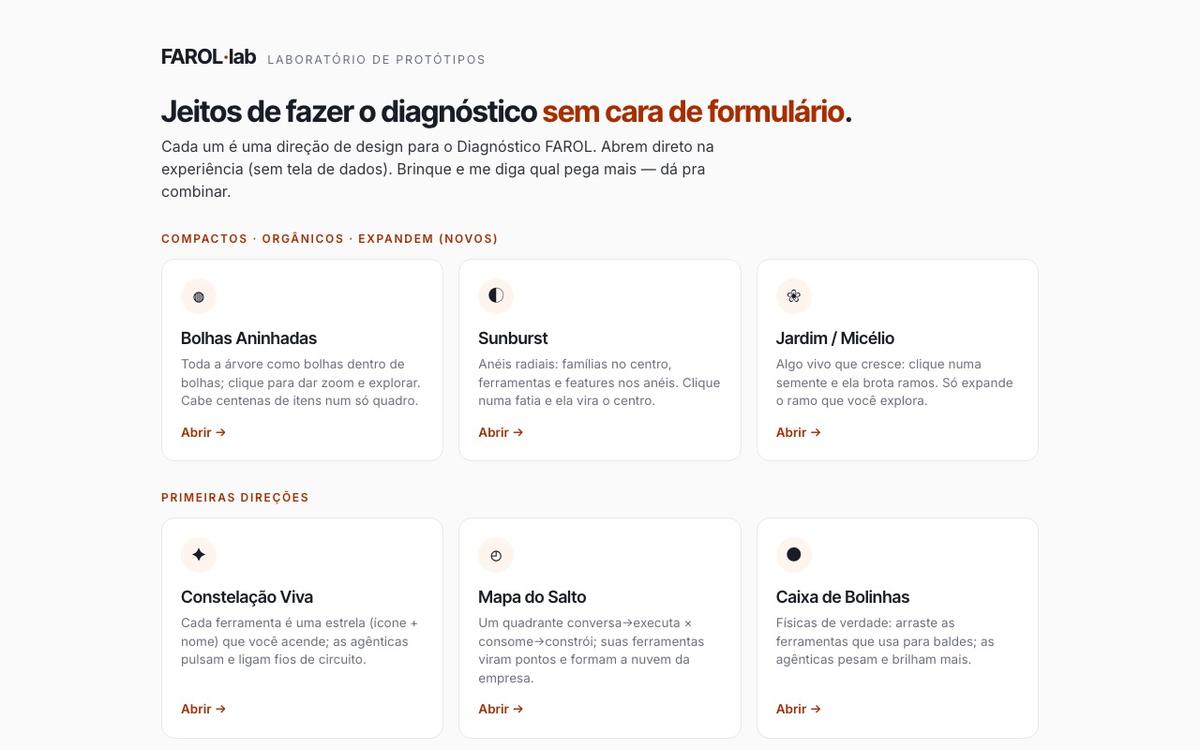
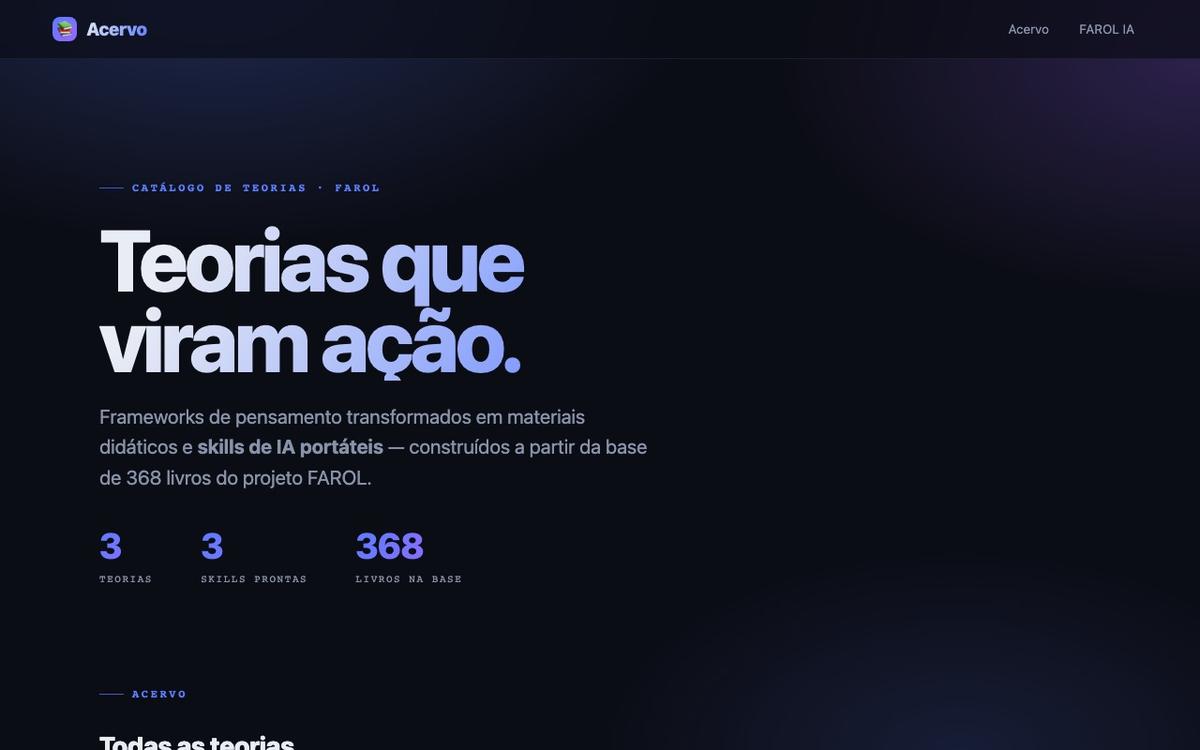
Acervo de Teorias Acionáveis
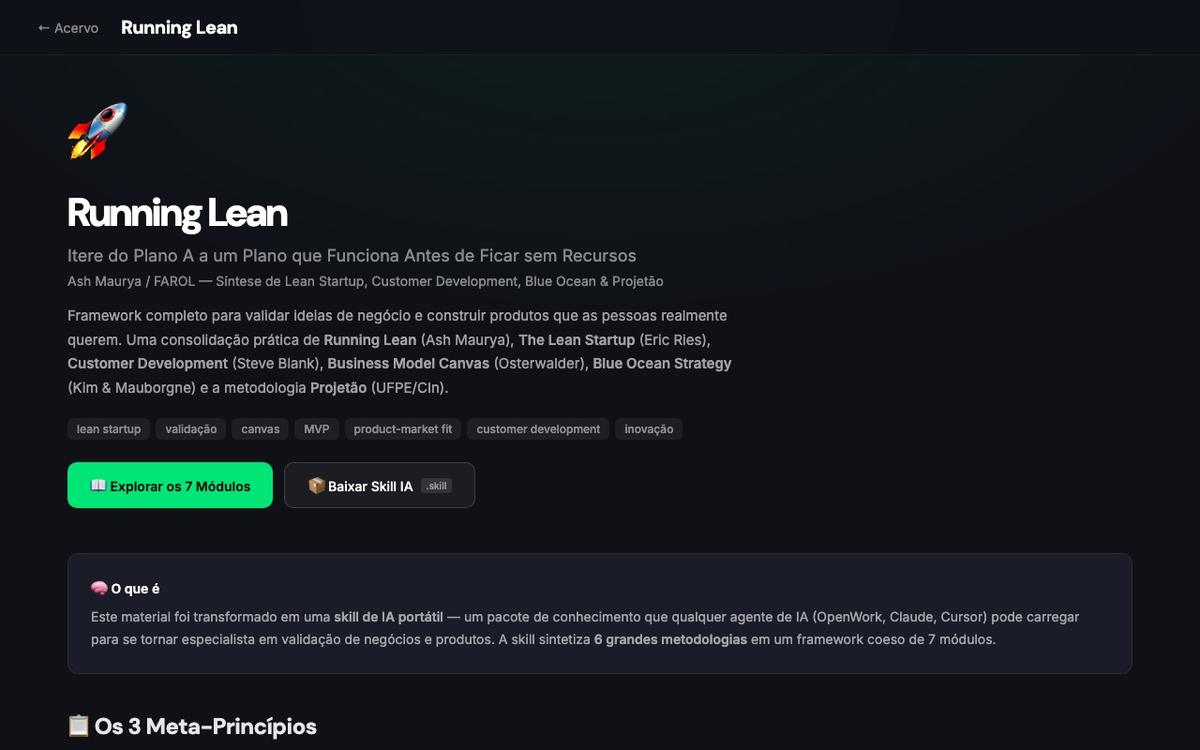
Catalog that turns management theories into teaching material and into a portable skill, a file that any AI assistant loads in order to apply the theory. Built in July 2026, it has 3 theories, 3 ready skills and 368 books in the database. The most complete module is Running Lean (https://farol-ia.org/running-lean/), open and with the skill available for download: three meta-principles, three stages and seven modules, with the sources incorporated and a section linking the method to the principles of Projetão.
- Link:
https://farol-ia.org/acervo/ - Status: active; three complete modules.
Meu Mapa de IA
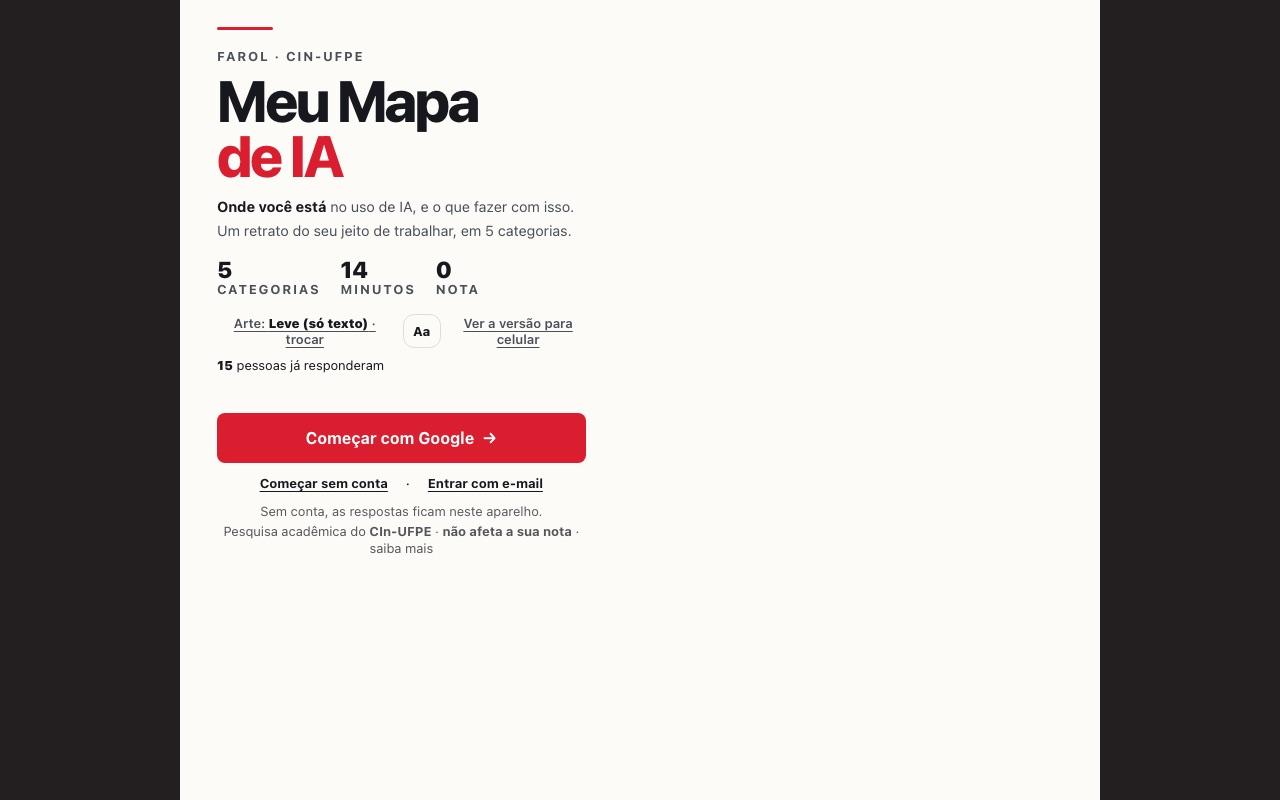
Research instrument in the form of a game: it measures how Brazilian students work with AI, in about fourteen minutes. Consent and the scope of data collection are on screen, before the first question: who is conducting the research, what is collected, what it is for, and that answering or not answering does not affect grades.
- Link:
https://educacao.farolia.org· shortcuthttps://farol-ia.org/educacao/censo - Repository: private.
- Status: active.
AI adoption observatory
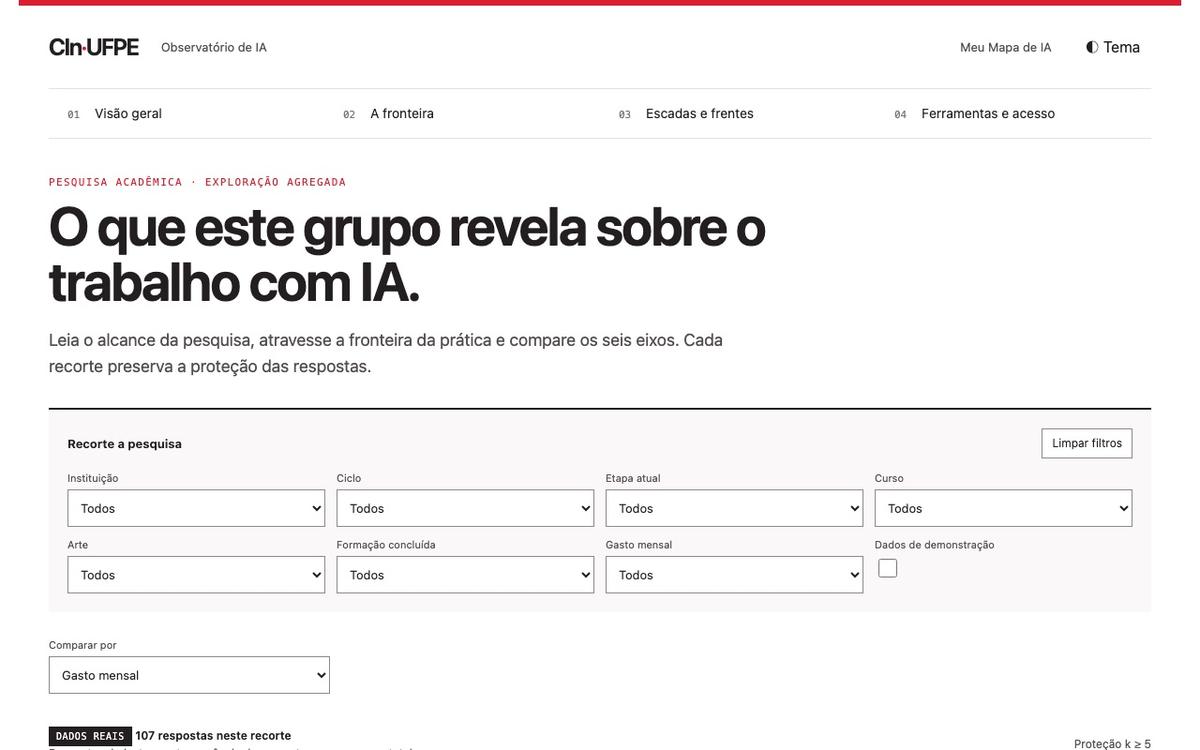
The aggregated reading of Meu Mapa de IA in four views (overview, the frontier, ladders and fronts, tools and access), with protected counts and a visible update date. It shows no individual responses: count protection is part of the design.
- Link:
https://cin-observatorio-bi.vercel.app - Status: active.
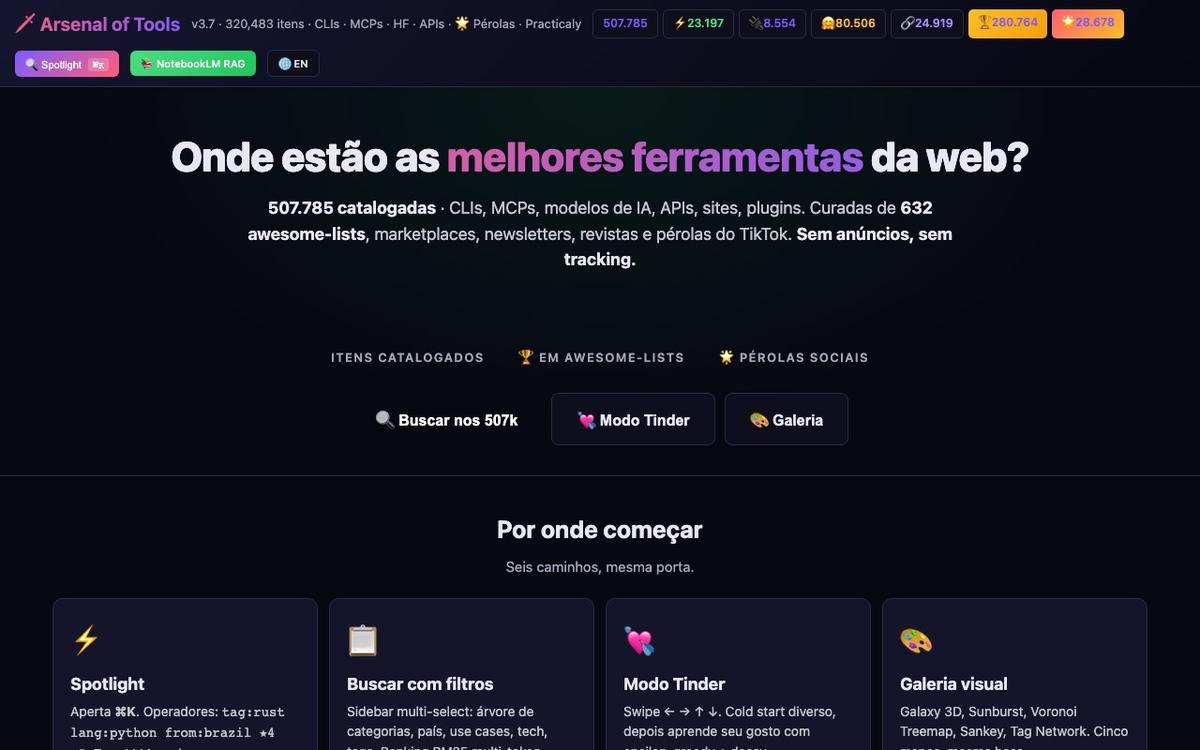
Mapa da Fluência Agêntica
Five visualizations of the same question bank: Giordano Map (periodic table of disciplines), Age of Fluência, Nautical Chart, Factory and Reading Room. The same base read from five angles, to see how much the visualization changes the question. The base, in version 0.3, has 330 questions, 15 disciplines and 22 symptoms; curation by Giordano Cabral, design and technical work by Filipe Calegario.
- Link:
https://mapa-fluencia-agentica.vercel.app - Status: active.
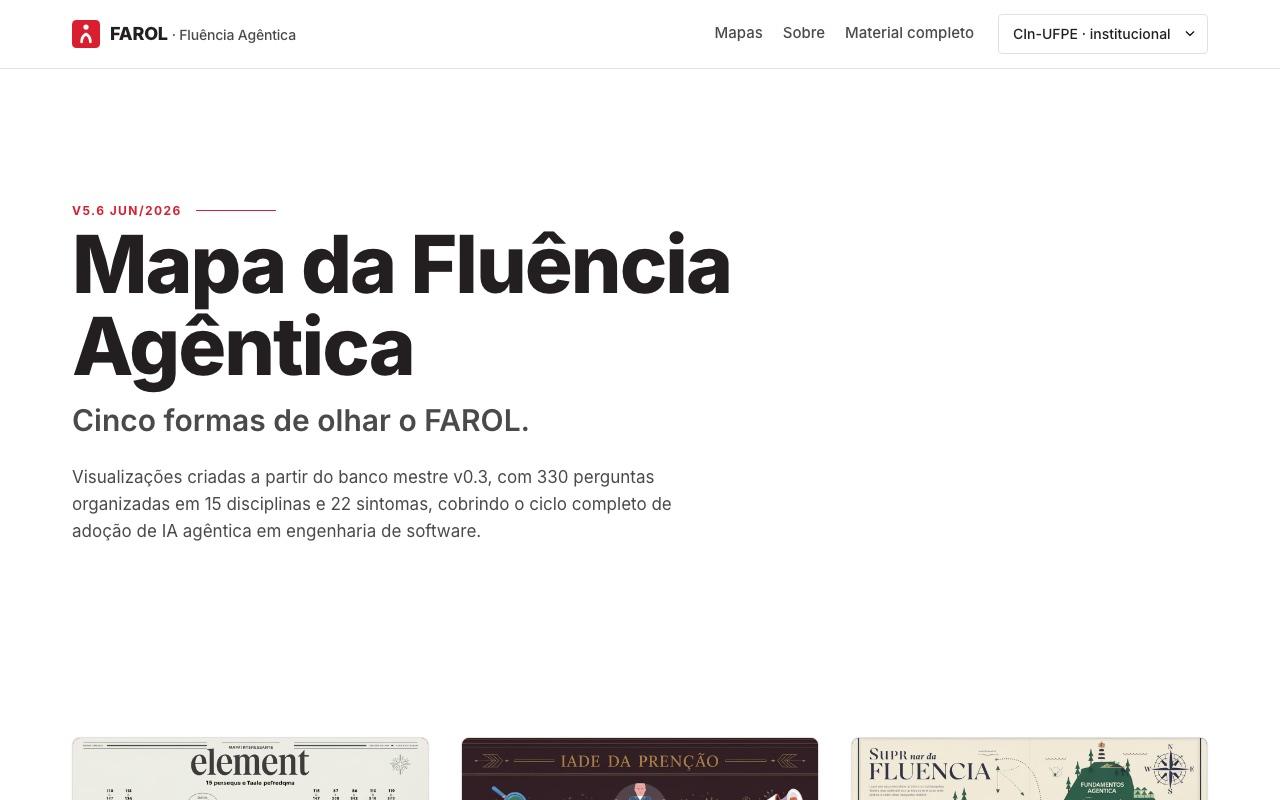
Operational fluency assessment for software companies
Version of the instrument aimed at software companies: 37 essential questions in about fifteen minutes, plus 77 optional ones, in four dimensions, with results shown as a radar chart. Made in partnership with an organizational maturity platform.
- Link:
https://farol-software-diagnostico.vercel.app - Status: v0.1, MVP.
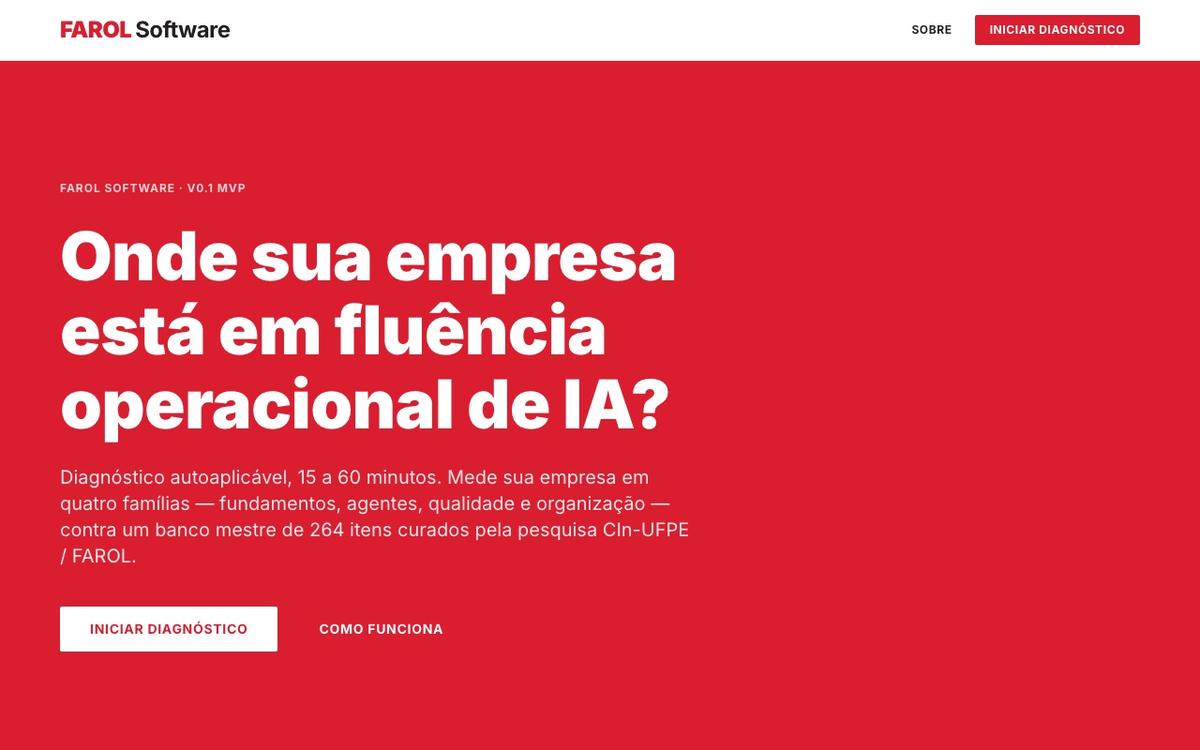
Telemetry benchmark for AI agents
Open curation of tools for observing work with agents (Claude Code, Codex, Cursor, Copilot and others): what each one records, what it misses and what changes from one choice to another. The comparison is by what the tool fails to see. It serves those who already use agents and need to measure what they do.
- Link:
https://telemetria-interacao-agentes.vercel.app - Status: active.
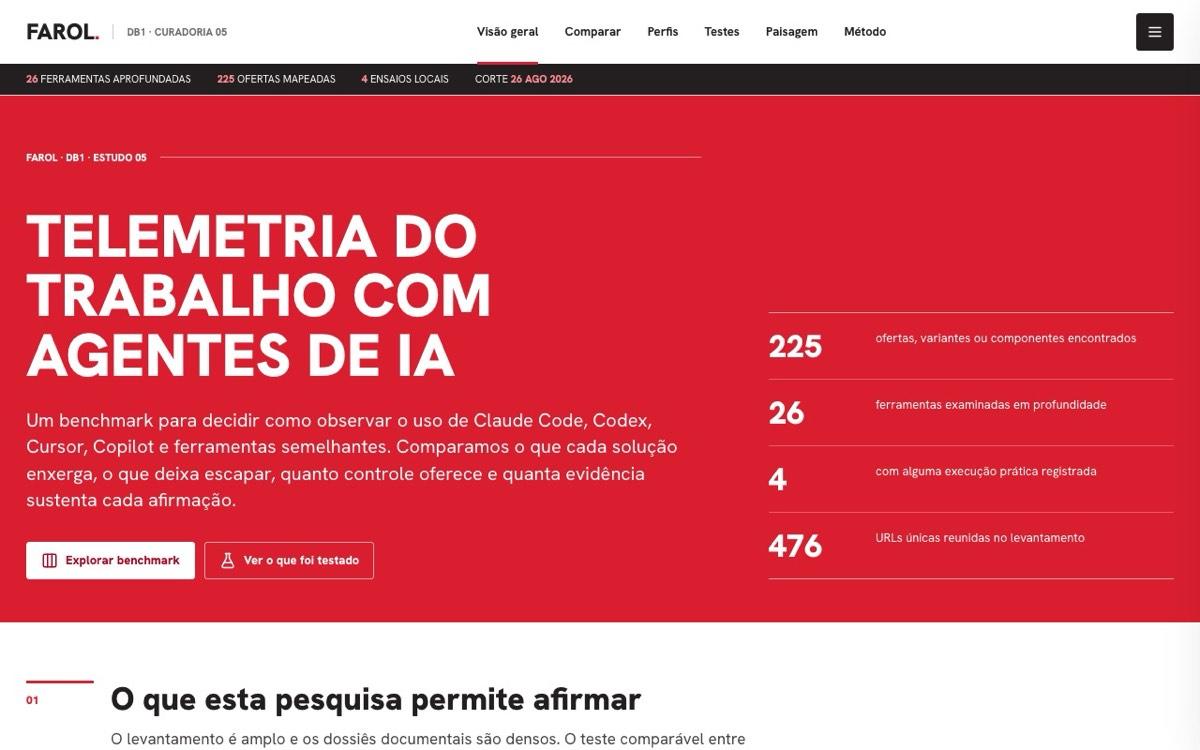
Arsenal of Tools
An open catalog of AI tools aggregated from hundreds of lists, marketplaces, and networks: CLIs, MCP servers, Hugging Face models, APIs, and discoveries from social media. Search via keyboard shortcut, item-by-item navigation, a complete tree, galaxy visualizations, and saved sessions. No advertising or tracking, in Portuguese and English. It is for people who code with AI and get lost in the volume of new tools each week.
- Numbers: version 3.7, with 320,483 items as of 09/18/2026.
- Link:
https://arsenal-of-tools.vercel.app - Repository: no public repository.
- Status: active.
Arena das IAs
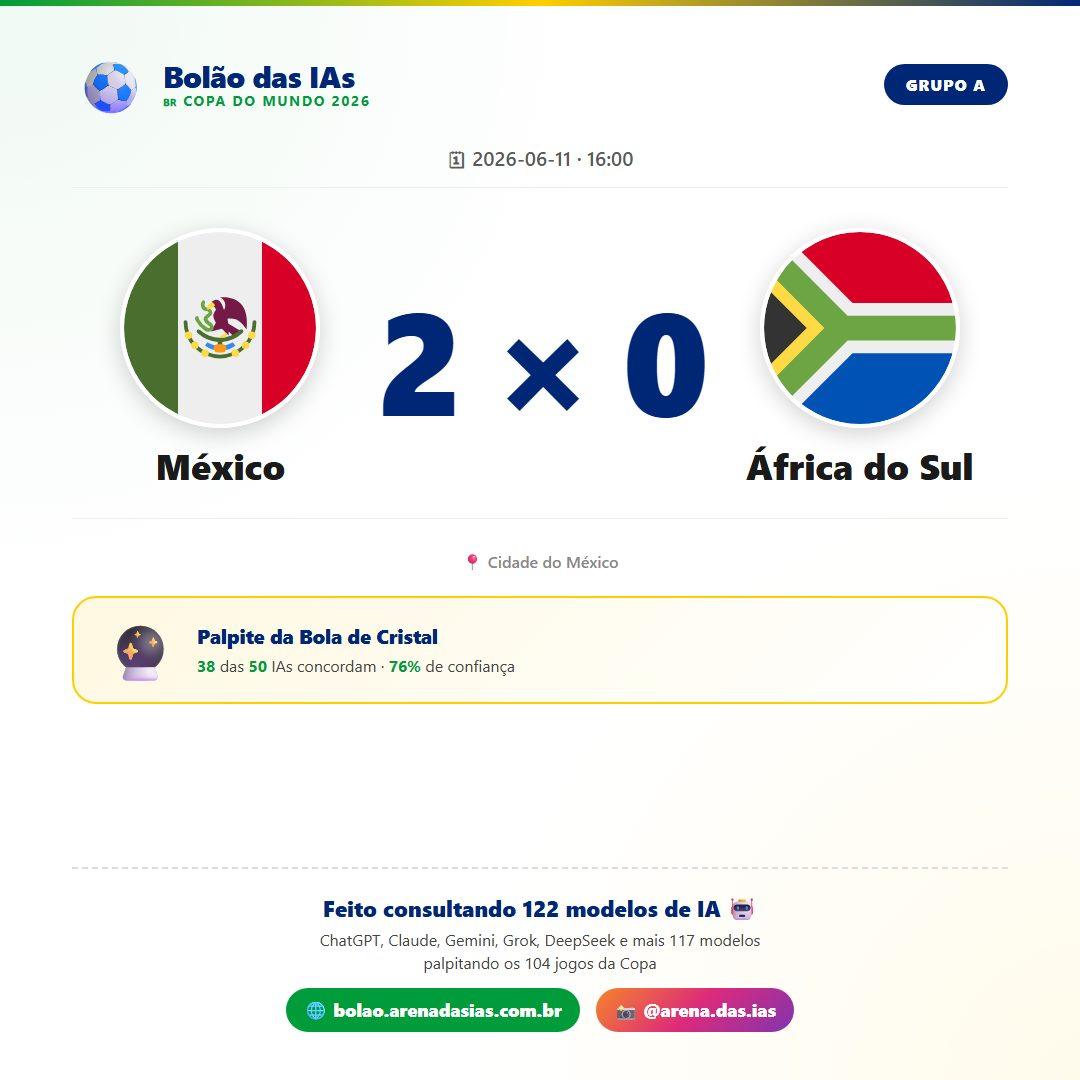
Home of public experiments with AI: "a space to play with artificial intelligence", with models from several families solving concrete problems. The method is to always use several AIs at the same time, comparing which AIs and not "the AI"; the rule, no advertising and no betting house. The audience is the Portuguese-speaking public in general, and the press.
- Link:
https://arenadasias.com.br· Instagram@arena.das.ias - Status: active.
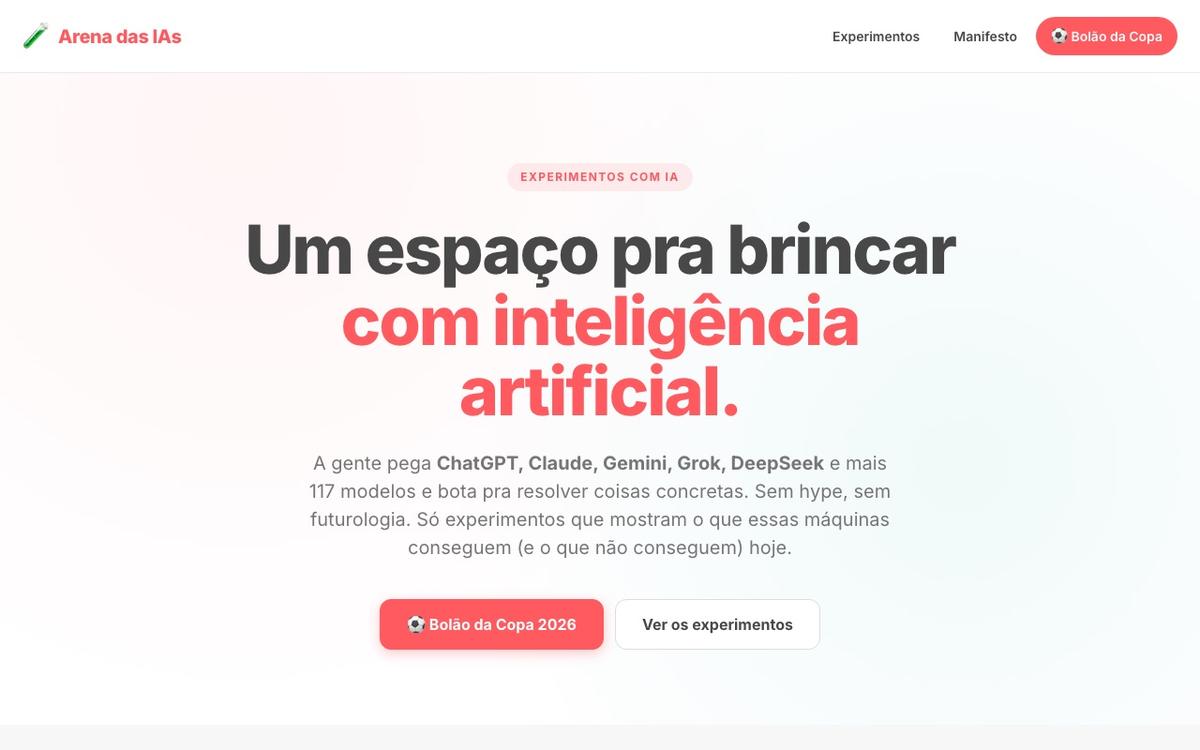
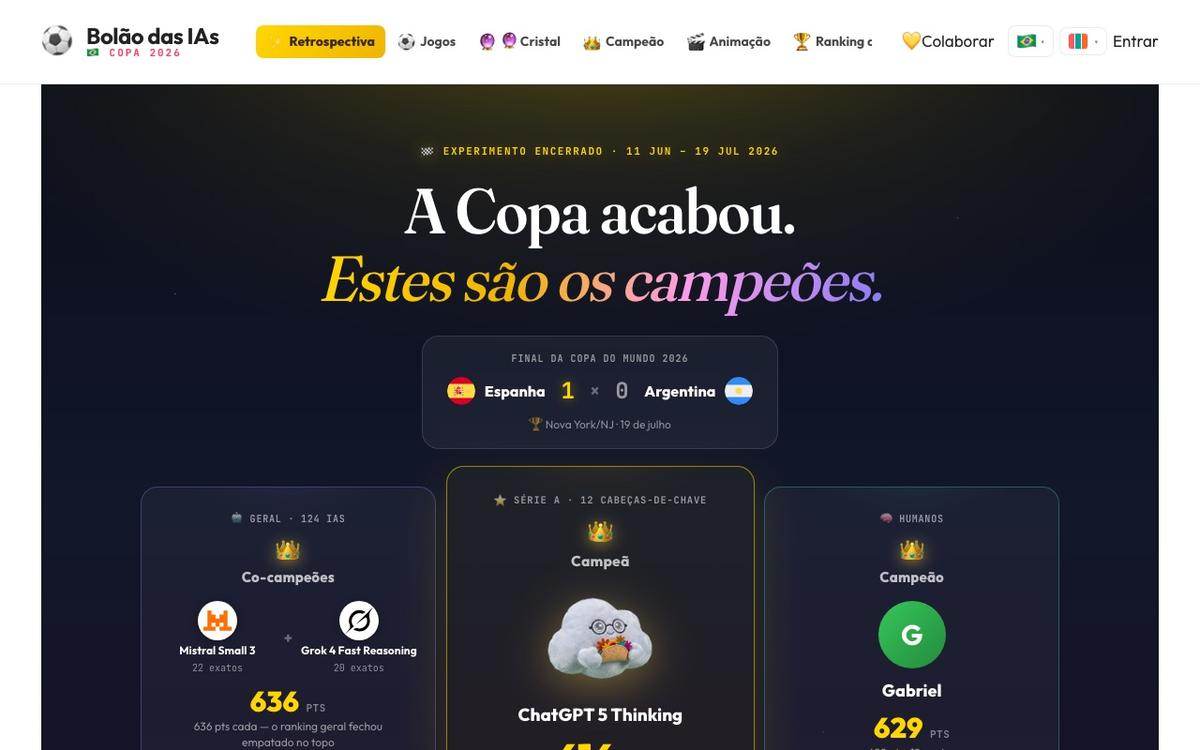
AI Pool · 2026 World Cup
The experiment that gave rise to the Arena: 124 models predicted the 104 matches of the 2026 World Cup under the same pool rules as the humans, with a public ranking, a consensus ("crystal ball") and an upsets scoreboard. There were 5,797 predictions over 38 days (06/11 to 07/19/2026); among the AIs, Mistral Small and Grok 4 Fast Reasoning finished tied for first with 636 points, "Series A" went to ChatGPT 5 Thinking (616) and the best human beat 121 of the 124 AIs.
- Link:
https://bolao.arenadasias.com.br - Repository:
https://github.com/giordanorec/bolao-copa-2026(public). - Status: concluded for the 2026 World Cup cycle; the site remains online as an auditable archive.
- Coverage: two stories on the CIn-UFPE portal (06/11 and 07/22/2026), one on g1 Pernambuco and one in Folha de Pernambuco.
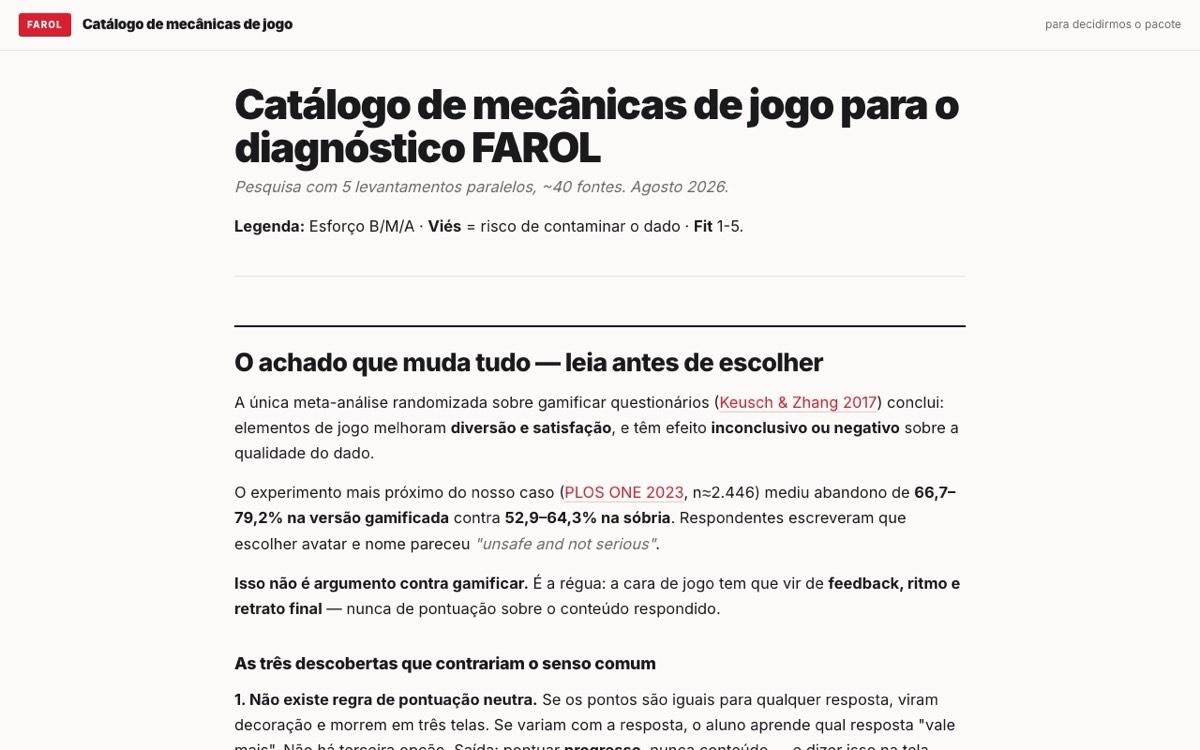
Catalog of game mechanics
An open research document from August 2026 on what happens when a data collection instrument is gamified: five parallel reviews and around forty sources, covering the effort, risk of bias and suitability of each mechanic. The finding that opens the document runs counter to conventional wisdom. The meta-analysis by Keusch and Zhang (2017) concludes that game elements improve enjoyment and satisfaction, with inconclusive or negative effects on data quality; an experiment published in PLOS ONE in 2023 (n≈2,446) measured dropout rates of 66.7% to 79.2% in the gamified version, compared with 52.9% to 64.3% in the plain version. It is for anyone planning to gamify a questionnaire who needs to know this beforehand.
- Link:
https://mecanicas.vercel.app - Status: active.
Radar for AI developments
Automated scan, run twice a day, that produces a daily briefing and a monthly roundup of AI news. No public page yet.
02 · Projects
Teaching and research
What he uses in class and what supports his research: a course system, the Projetão method packaged for AI, two research game platforms, and the working memory that keeps all of it consistent across sessions.
Hiper Deep Research
A system in which students scan tens of thousands of tools with an AI and narrow them down to one: 10,000 → 500 → 50 → 5 → 1, in two independent units, inspiration tools (what the student uses) and development tools (what the student's code uses). Delivery takes place inside the system: login through the CIn login, submission of the 500, item-by-item screening by keyboard, choice of the 50, and the class's live list. A tool belongs to one student per unit, enforced by a database key; telemetry records the time spent on each item, because what is assessed is the process.
The page speaks directly to the student's AI. An llms.txt file defines the contract: the AI writes the collector and runs the batch judgment with the student's criteria, but does not choose for the student, does not invent links, and does not hand over finished work.
- Technology: no build and no framework; native ES modules, with Supabase behind it.
- Link:
https://giordanocabral.com/tmi/26-2/hdr/ - Repository:
https://github.com/giordanorec/tendencias-midia-interacao(public). - Status: active, in use by the 2026.2 class.
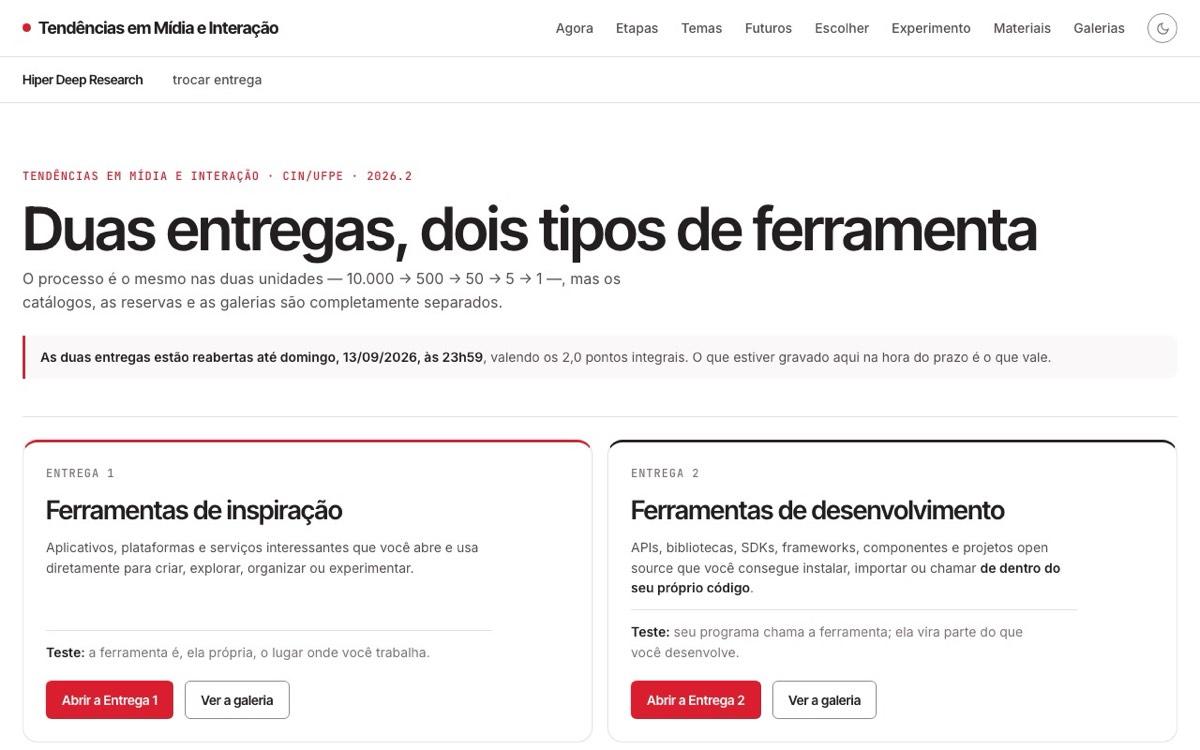
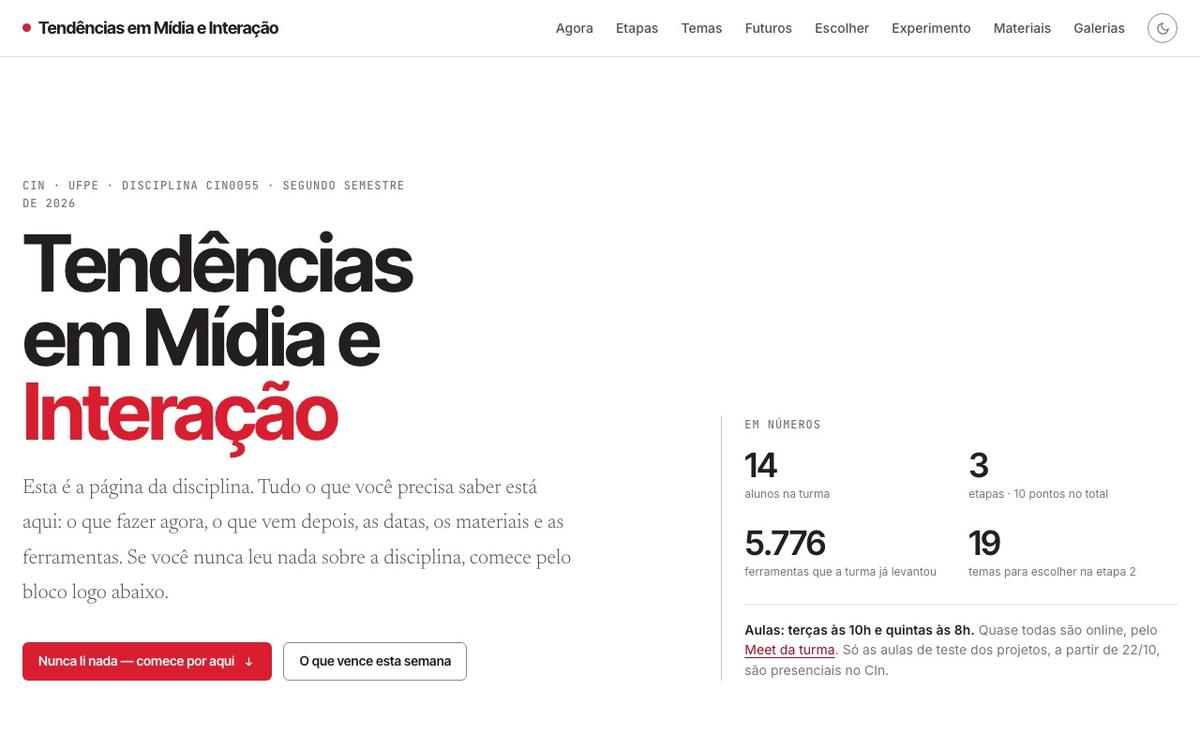
Course hub for Tendências em Mídia e Interação
The site that runs the course CIN0055: deadlines, stages, themes, materials, galleries, and the page for each theme, on the CIn server.
- Link:
https://giordanocabral.com/tmi/26-2/ - Status: active.
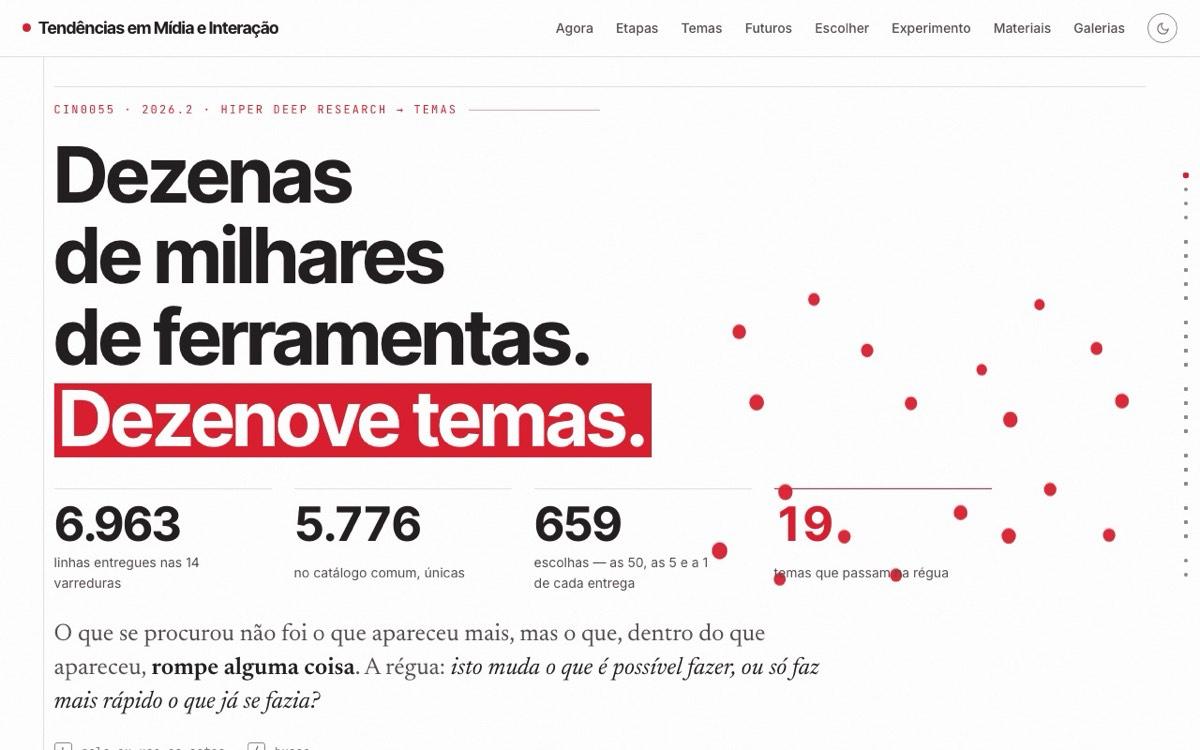
The deep dive into the 19 themes page shows the funnel that generated the themes, the map of the five families, the mature-emerging scale for each one, and the questions for classroom discussion. The numbers come from the class itself: 14 scans, a shared catalog, and 659 choices, of which fourteen are first places.
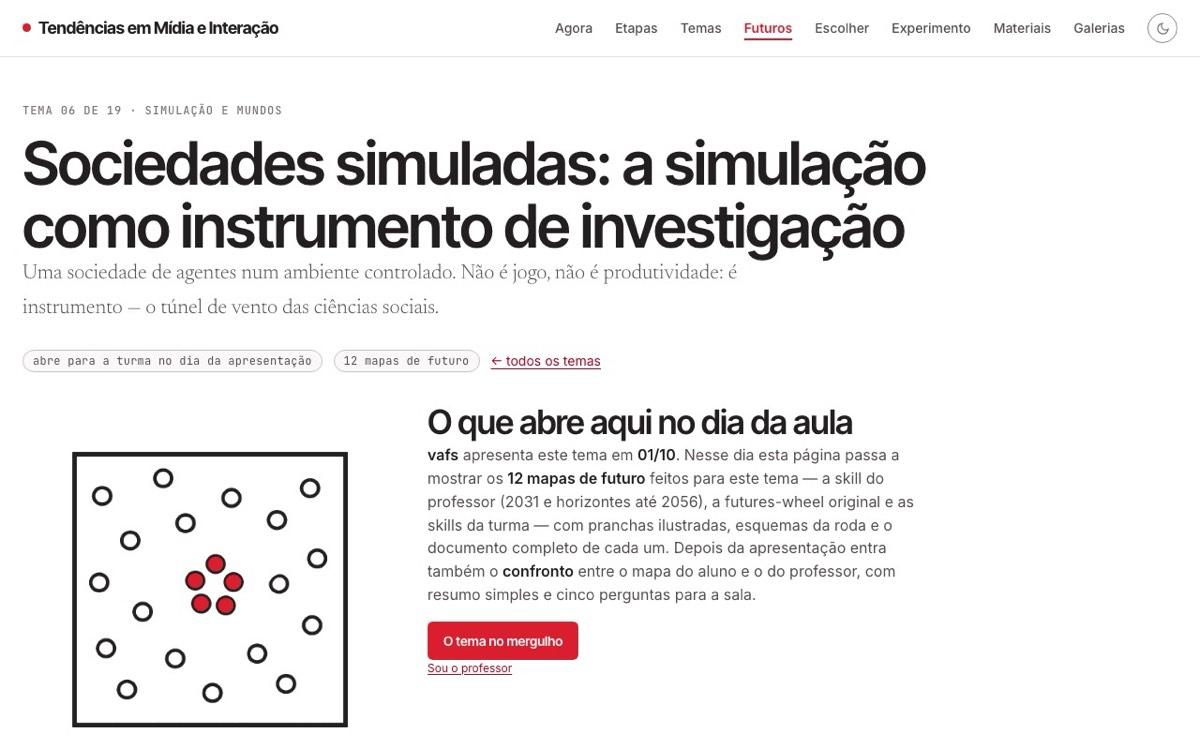
Each theme has its own future page, which opens to the class on the day of the presentation, with the future maps, the original futures diagram (futures wheel), and the comparison between the student's map and the professor's.
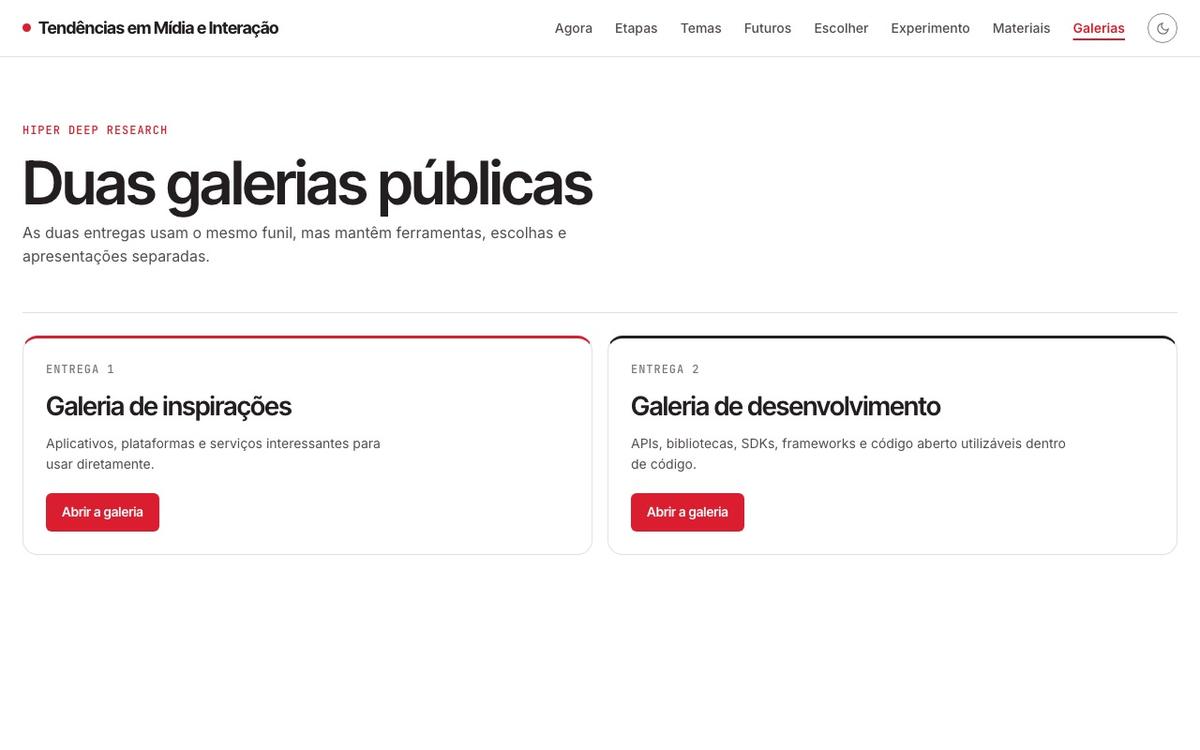
The public galleries show what the class selected in the two Hiper Deep Research units.
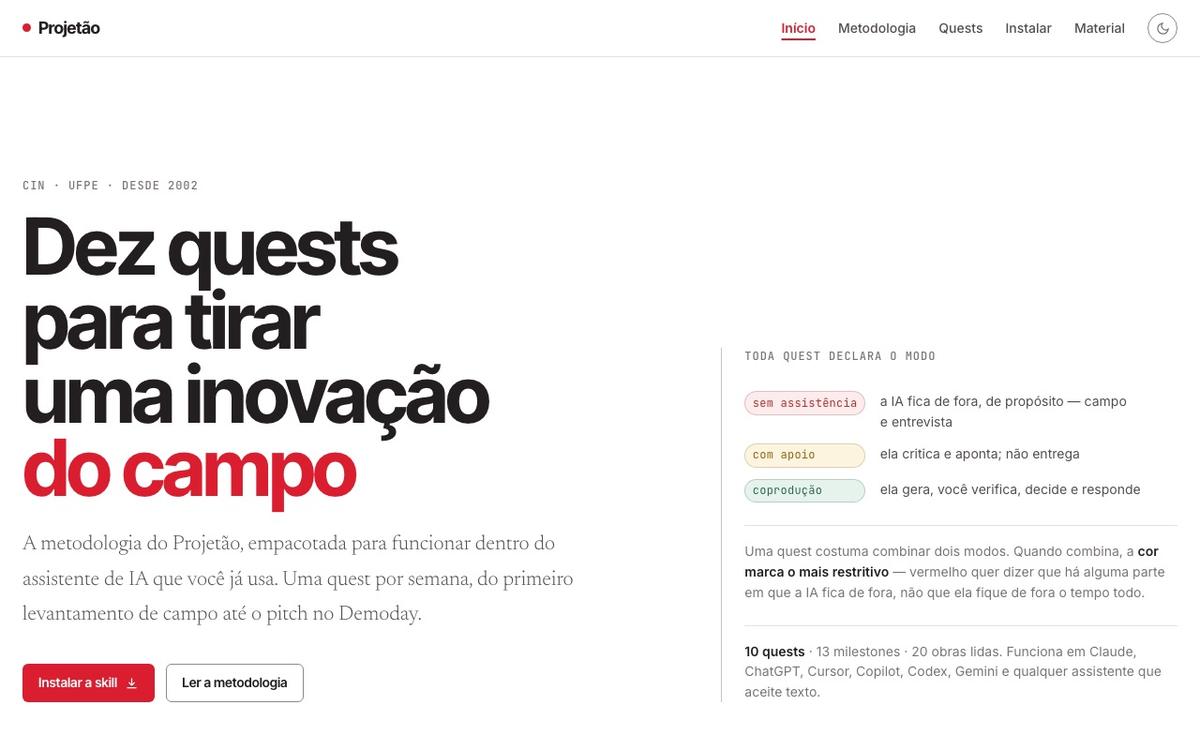
Projetão for the AI era
The innovation project methodology of CIn-UFPE, created in 2002, packaged as a skill to work inside the assistant the person already uses: Claude, ChatGPT, Cursor, Copilot, Codex, Gemini. Ten quests, one per week, from the first field survey to the pitch at Demoday, with 13 milestones and 20 reference works.
Each quest states its mode of AI use: unassisted (fieldwork and interviews, by design), supported (AI critiques and points things out), and co-production (AI generates, the person verifies and takes responsibility). The color indicates the quest's most restrictive mode.
- Link:
https://projetao-ufpe.vercel.app - Repository: no public repository; the source corpus carries third-party rights.
- Status: active.
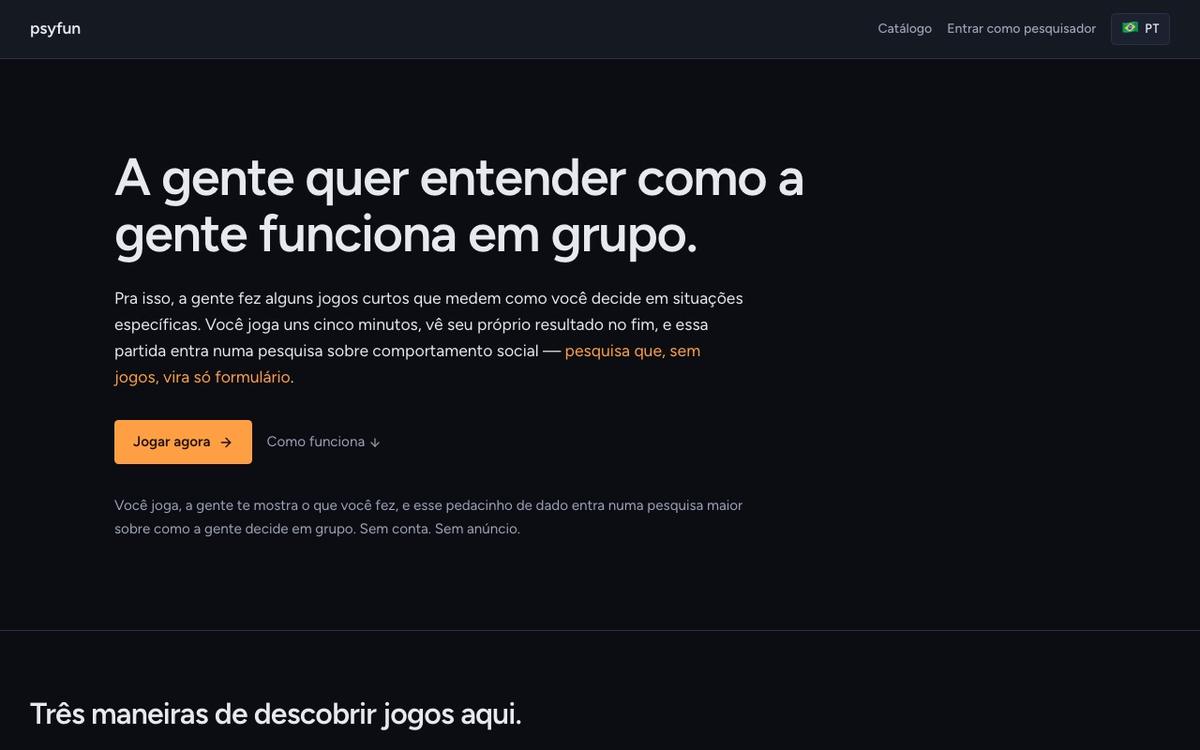
PsyFun Platform
A platform of short games that measure decisions in social dilemmas (cooperation, common resources, game theory). A round lasts about five minutes; players see their own result at the end, and the round feeds into research on social behavior. No account and no ads, in Portuguese, English, and French. It is research that, without the game, would become a questionnaire. Version 1 includes the game sheet for Açude ("how much do you cooperate when no one is watching").
- Group: PsyFun, CIn-UFPE with UNIVASF.
- Link:
https://psyfun-platform.vercel.app - Repository: private.
- Status: active, v1.
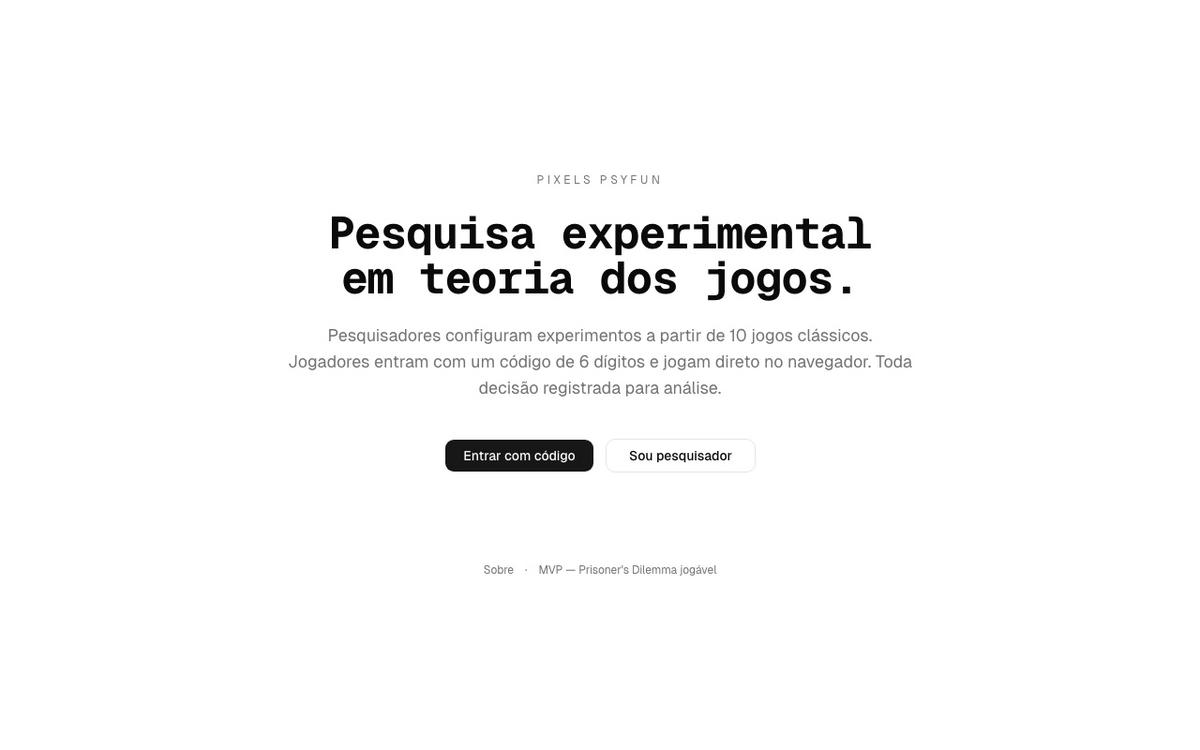
Pixels PsyFun
A platform for setting up game theory experiments with the Pyxel engine running in the browser: the researcher configures the experiment using classic games, opens a room with a six-digit code, anonymous players join, and the resulting data is granular and ready for analysis.
- Link:
https://pixels-psyfun.vercel.app - Repository: private.
- Status: MVP, v0.1.0.
There is also the PsyFun Catalog, with 1,202 moddable games assessed for use in research (CC BY 4.0 license), at https://github.com/giordanorec/psyfun-catalogo.
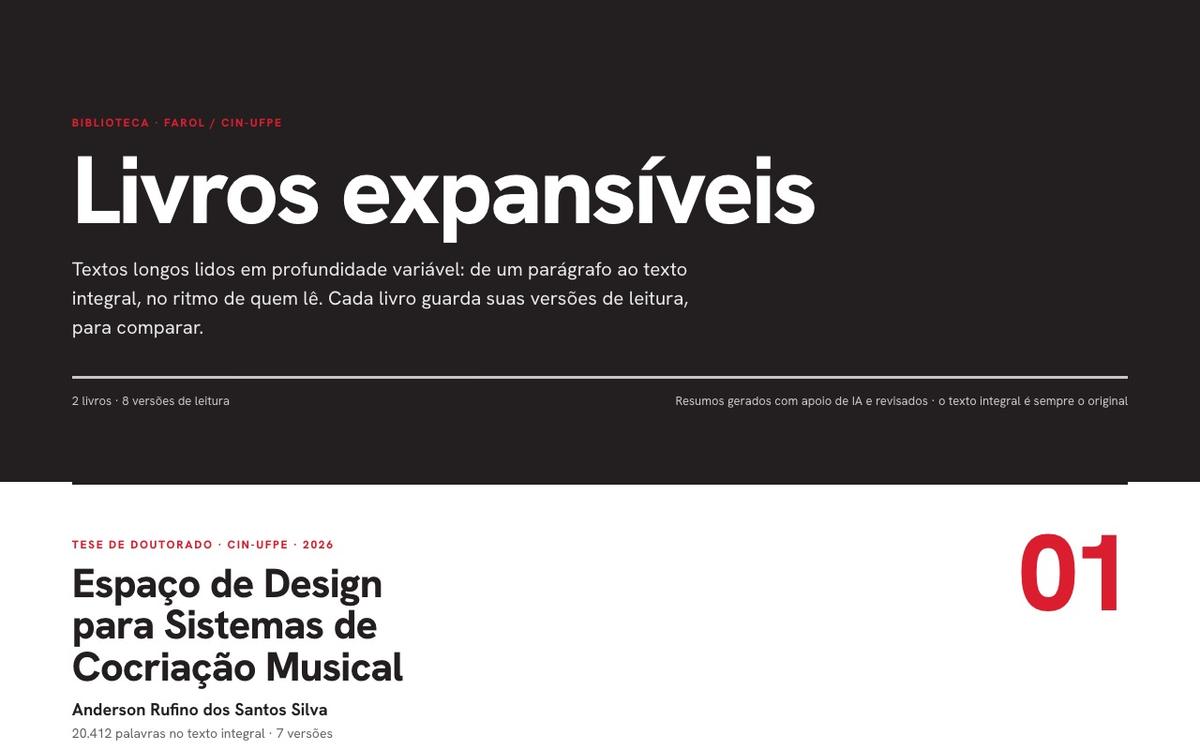
Livros expansíveis
A reader that opens a long text at variable depth: from a single paragraph to the full text, at the reader's pace, keeping the reading versions for comparison. In September 2026 the library held 2 books and 8 reading versions. Three reading designs coexist: five fixed levels (a global slider, with each section able to be pinned to its own level), recursive expansion (each click opens one level below, in place), and text with the examiners' comments anchored to the passage they refer to. The summaries are AI-assisted syntheses, declared as such, and the "full text" level reproduces the original unaltered.
- What is on the shelf: the CIn-UFPE doctoral thesis Espaço de Design para Sistemas de Cocriação Musical (Design Space for Music Co-creation Systems), by Anderson Rufino dos Santos Silva, defended on 09/15/2026, with 20,412 words and seven reading versions.
- Link:
https://livros-expansiveis.vercel.app - Status: active.
LLM-Wiki and the decanting protocol
A working-memory method for people who work with several AI sessions: a living base that the AI itself compiles and maintains from the sources (transcribed meetings, notes, messages), organized by knowledge (concepts, projects, people) rather than by conversations; plus a second layer in which each decision is recorded in a file with the reasoning, the discarded alternatives, and how to check whether it is being respected. Three operations: ingest, ask, and review the health of the base.
- Figures as of 09/03/2026: 958 sources, 38 concepts, 32 projects, 180 people, and 24 organizations; ingestion four times a day and weekly review.
- Public link: none; the content is working material. The method and the tool below remain open.
- Status: active.
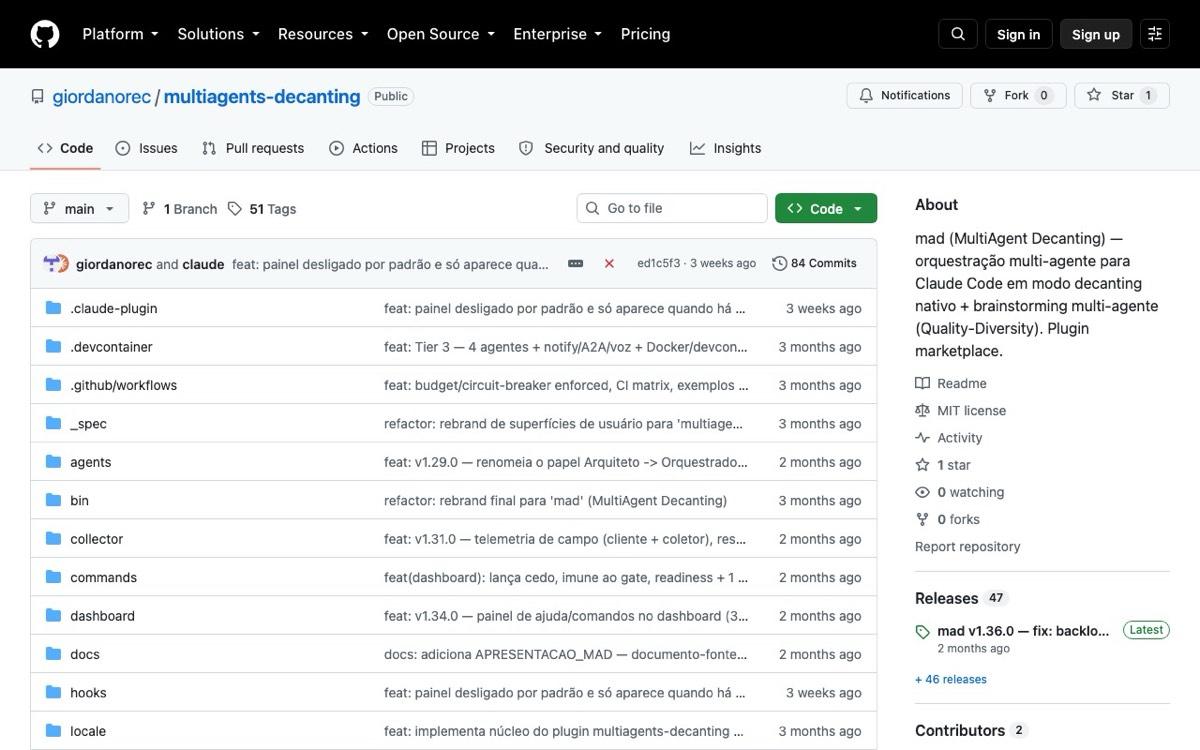
The public artifact of this line is mad (MultiAgent Decanting), an open plugin (MIT license) that puts a team of agents to work with a built-in decision log, distributed through an open plugin marketplace.
- Repositories:
https://github.com/giordanorec/multiagents-decantingandhttps://github.com/giordanorec/ai-coding-tools(public). - Status: active.
Open-source games
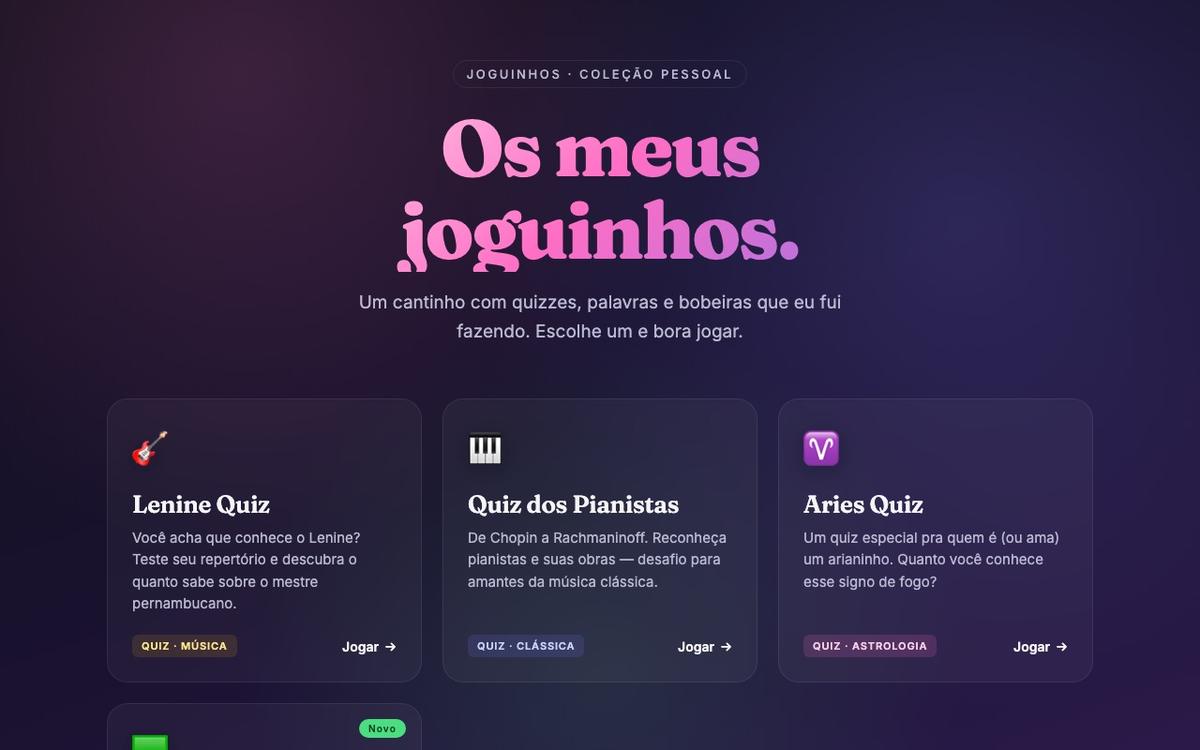
Two public repositories of games made outside the courses. Os Cabra is a vertical shoot 'em up in Phaser 4 and TypeScript themed on the cultural manifestations of Recife (https://os-cabra.vercel.app). Joguinhos do Gi brings together Palavrim, a Portuguese-language version of the word-guessing game, and three quizzes (https://small-games-rho.vercel.app).

03 · Projects
Music
A published app, an analysis tool from 2007 that returned as a skill, a personal guitar study that became a website, the research group, and a composition tabletop prototype.
iChords
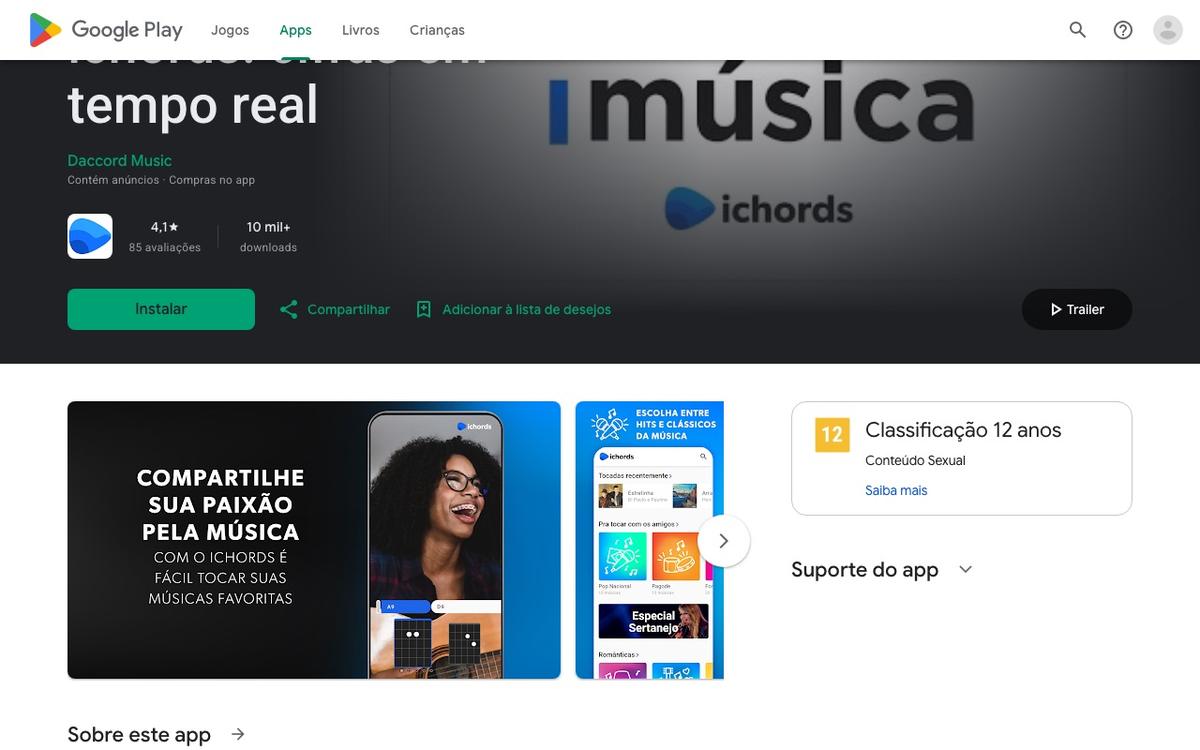
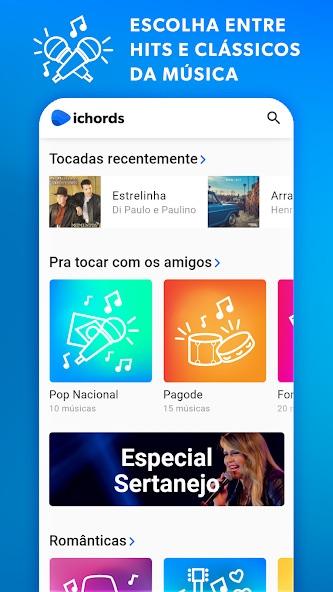
A real-time chord chart app: the chord chart follows the music as it plays, with playlists, a setlist, a metronome, and key and speed adjustments, as well as video recording of performances for sharing. It is published by Daccord Music Software, a company that originated at CIn-UFPE and of which Giordano Cabral is a founder.
- Store: Google Play,
com.ichords.android, with 10K+ downloads and 85 ratings as of 09/18/2026; last app update on 08/25/2025. - Two generations: iChords 2.0 for Windows (2008) recognized chords in an audio file and displayed them on a guitar fretboard or keyboard; the current app, released in 2022, starts with music that already has a chord chart and synchronizes the two.
- Link:
https://ichords.app/·https://play.google.com/store/apps/details?id=com.ichords.android - Repository: no public repository.
- Status: published and available.

HarmIn
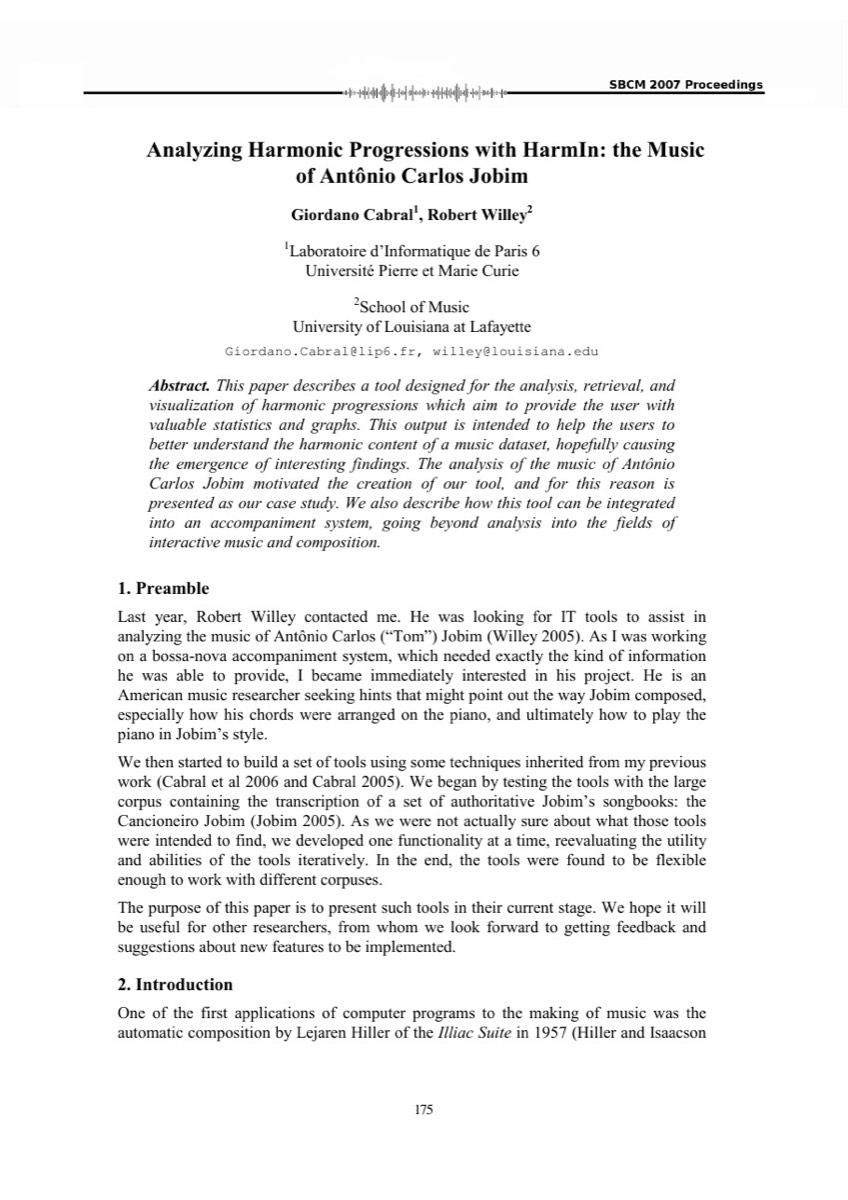
A tool for analyzing, retrieving and visualizing chord progressions: it produces statistics and chord-transition graphs, so that patterns emerge on their own across a set of songs. It came out of a study of the work of Antônio Carlos Jobim based on the Cancioneiro Jobim, and was presented in the paper Analyzing Harmonic Progressions with HarmIn: the Music of Antônio Carlos Jobim, by Giordano Cabral (LIP6, Université Pierre et Marie Curie) and Robert Willey (University of Louisiana at Lafayette), which received the Best Student Technical Paper Award at the 11th SBCM (São Paulo, 2007; symposium page). The paper describes how the tool moves from analysis into an accompaniment system: from reading to interactive music.
- Link:
https://compmus.ime.usp.br/sbcm/2007/papers/sbcm-2007-15.pdf - 2026 version: an AI skill reproduces the paper's graph for any artist or style, collecting chord charts and building the transition matrix on the circle of fifths. No public repository.
chord-site
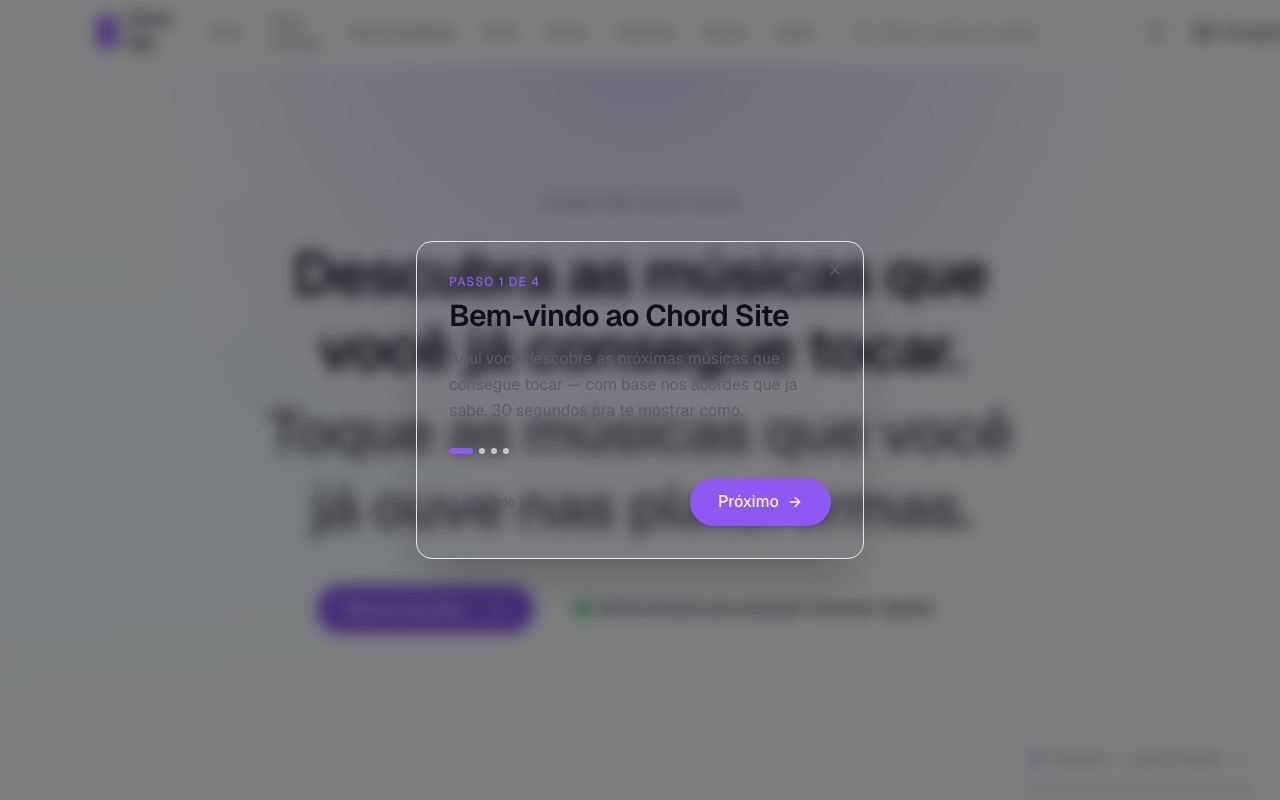
A personal guitar-study project that became a website: the user marks the chords they already know, per instrument, and receives the songs they can play now, the ones that fit with a transposition, and which chord to learn first to unlock more songs. By connecting Spotify or YouTube, the list prioritizes what they already listen to. Nine instruments (guitar, electric guitar, ukulele, cavaquinho, bass, piano, banjo, mandolin and tres) and four languages. It is for people who are learning and want to play something today, without learning anything new first.
- Link:
https://chord-site-two.vercel.app(optional login) - Repository: private.
- Status: live.
MusTIC · Music, Technology, Interactivity and Creativity
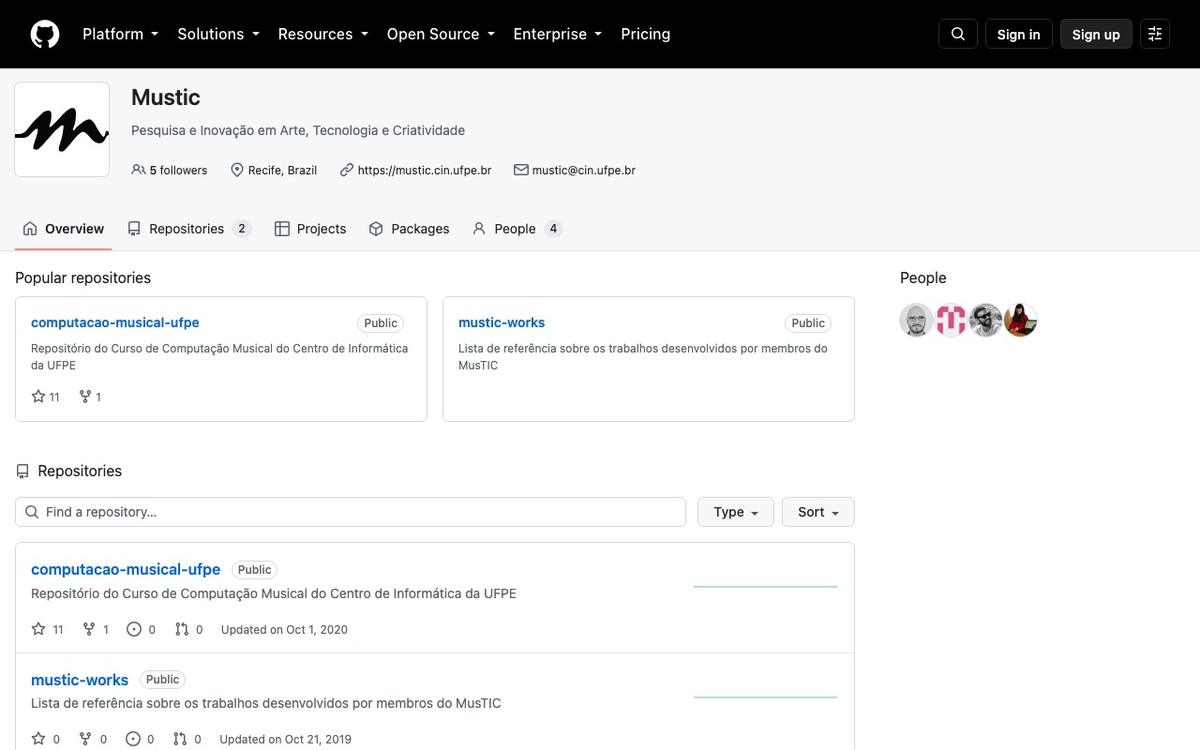
Research and innovation group at CIn-UFPE in art, technology and creativity, with work in physical computing, interaction design and signal processing, from digital instruments to performances. Coordinated by Geber Ramalho, Giordano Cabral and Filipe Calegario. Milestones include the best paper award at the 17th Brazilian Symposium on Computer Music (2019) and the organization of the 18th SBCM (2021), in partnership with CESAR.
- Link:
https://mustic.cin.ufpe.br· contactmustic@cin.ufpe.br· Instagram@musticpe - Open repositories: the
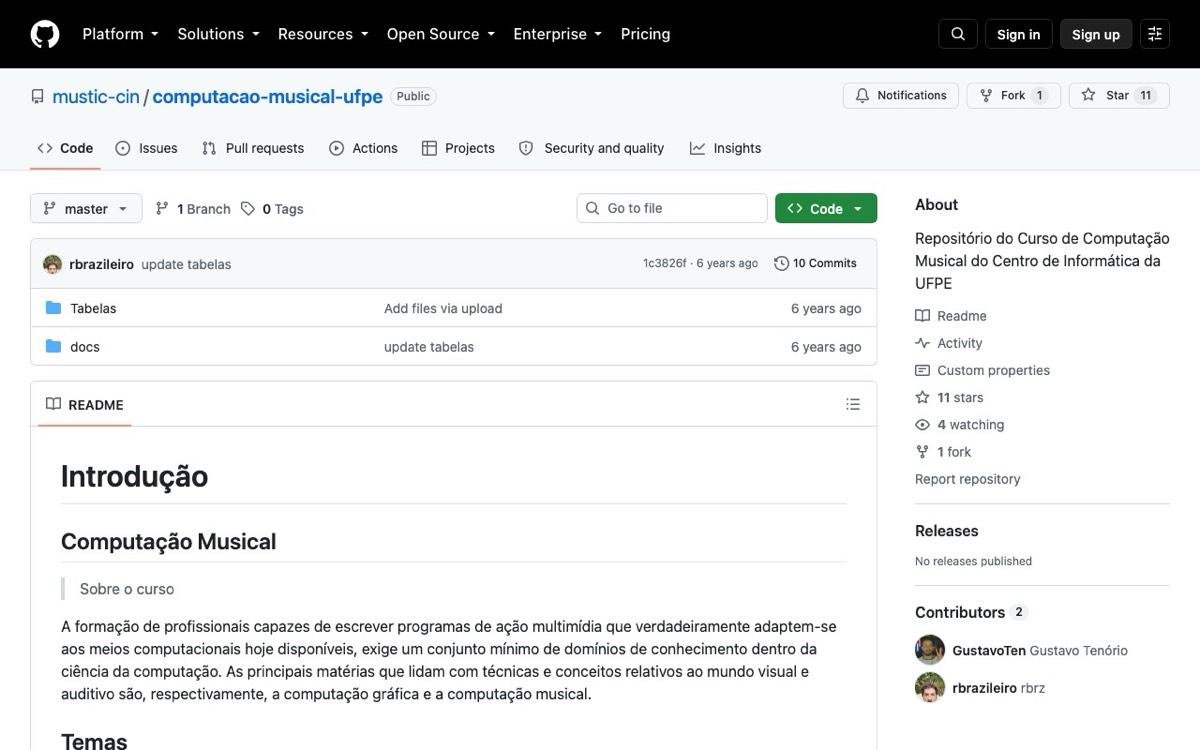
https://github.com/mustic-cinorganization, with the CIn Computer Music course (computacao-musical-ufpe) and a reference list of the members' work (2019). - Status: active group.
Music.AI Workflow · visual composition table
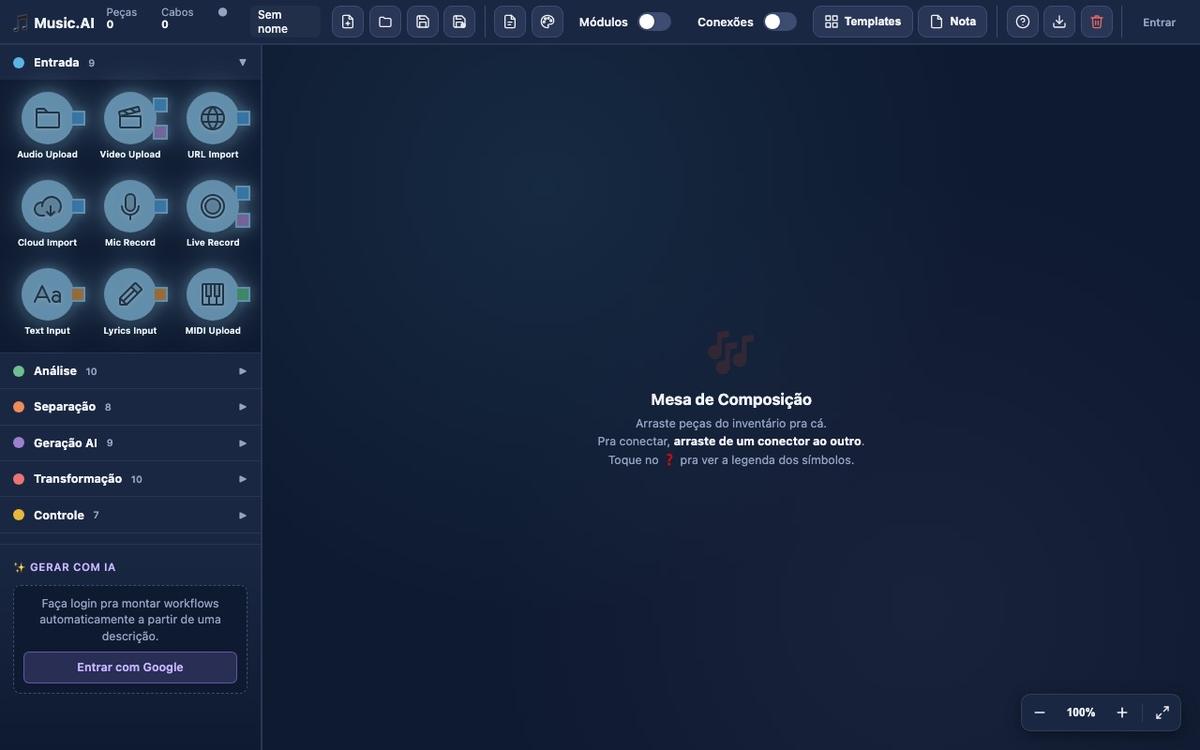
Interface prototype in the style of a Reactable table for assembling music-processing flows: circular modules in about nine categories, cables typed by signal nature (audio, MIDI, chords, text, data, control, video), ready-made templates and JSON export. It does not run anything: it serves as a visual brief for product and engineering teams.
- Link:
https://music-ai-ebon.vercel.app - Status: prototype, idle since April 2026.
04 · Projects
Images from the archive

Frequently asked questions
What is Arena das IAs?
A public experiment in 2026: 124 artificial intelligence models predicted the outcomes of all 104 World Cup matches under the same rules, with rankings, predictions, and explanations open to public scrutiny.
What open tools does FAROL publish?
Arsenal of Tools (a catalog of AI tools, CLIs, MCPs, models, and APIs), Acervo de Teorias Acionáveis, Meu Mapa de IA (a census of student fluency), and Arena das IAs.
What is Hiper Deep Research?
The system of the course Tendências em Mídia e Interação in which students scan tens of thousands of tools with the help of AI and narrow them down to one, in two units (the one they use day to day and the one their code uses), with a deliverable, batch judging and a public gallery.